What's the difference?
So, you’re after an affordable alternative to the increasingly expensive Toyota HiLux and Ford Ranger. You need it to be tough enough for work, but also big and comfortable enough to haul family every now and again.
It’s a common predicament, and one that's increasingly served by Chinese and Korean alternatives.
Today, we’re looking at LDV’s latest effort - the T60 Max Plus. While it looks like just another new variant from the outside, it’s hiding some significant changes underneath, and it takes its place at the top of the T60 range in 2024.
Could it be the right ute to fit your budget? Let’s take a look.
I know what you're thinking: "How is this thing legal?" And to be honest, somewhere between a rock flung from the tyre of a passing car colliding with my forehead like it had been fired from a pistol, and the pouring rain lashing my exposed face like a damp cat-o'-nine-tails, I'd begun wondering the same thing.
The answer is barely. The product of a years-long fight to overcome our import rules, this madhouse KTM X-Bow R is now finally free to roam Australian roads and racetracks - though, with sales capped at 25 per year to comply with the Specialist Enthusiast Vehicle Scheme.
The price? A slightly eye-watering $169,990. That's quite a lot, and places the X-Bow R miles above its closest lightweight, carbon fibre-tubbed competitor, the Alfa Romeo 4C ($89,000).
But then, the KTM X-Bow R is unlike anything else on the road today. Part super bike, part open-wheeler and all mobile madness, the 'Crossbow' is fast, furious and completely insane.
Expect no doors, no windscreen, no roof. On-board entertainment is limited to the turbo whistling behind your head, the car's standard safety list is as barren as the interior and the climate control is dependent on the temperature of the wind that's smashing into your exposed face.
And we couldn't wait to take it for a spin.
The Max Plus brings a lot of welcome upgrades to the T60 range, particularly in its previously non-existent active safety suite, but it’s not all good news. There are still a few areas where this ageing ute could use a lot of polish.
Still, there’s something to be said for how refreshingly straightforward much of it is, and for the most part its specs and features are up to the task of competing with many more expensive alternatives.
Okay, so rain is not your friend. Neither is brutal sunshine, strong winds or any speed bump anywhere. There are probably a handful of times you'll want to drive it, and when you do you will definitely get hit in the face with rocks and bugs, and spend most of your time wondering just how the hell this thing is legal.
And yet, we are hopelessly, head-over-heels in love with it. It's an absolute weapon on a track, a joy on anything even resembling a twisting road and it is one of the few genuinely unique cars on the road today. And the fact it exists at all is a cause for absolute celebration.
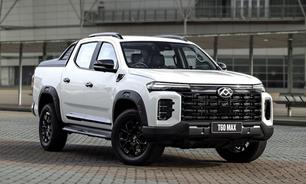
The T60 Max Plus takes the visage of a factory-kitted version of the existing T60 Plus. The most notable difference this time around is the unique gloss black grille design which features a new spot to hide the front radar array for the safety suite, alongside new gloss wheel designs and that huge sports bar fitting atop the tray.
To my eye at least the T60 looks a fair bit more rugged and industrial than most of its rivals, which with every iteration are looking more like passenger vehicles than work-ready utes. Still, there’s an aggressiveness to its contrast black trims and tall ride height which may appeal to some. For others it will be more function-over-form, with less bumper overhang than something like the SsangYong Musso and there’s something to be said for that, too, I suppose.
Inside is where this Max Plus version sets itself apart from the rest of the range with its abundance of screen real-estate, upgraded materials, and an almost EV-like centre console treatment.
It’s certainly more digital-feeling and contemporary than the rest of the T60 range, but it might lose some of the simple but rugged appeal of its interior as a result.
The screens look pretty slick, especially when you’re using phone mirroring to hide the otherwise clumsy stock software suite. It’s one thing to have nice big screens, it’s quite another to have slick, attractive, and customisable software to match.
Sadly, that’s not the case for the Max Plus, which offers one lacklustre look and feel for the dash cluster, paired with an array of confusing menus on the multimedia screen.
The X-Bow R is built for purpose in the most wonderful of ways. From the visible suspension components to the rocket-style exhausts, to the stripped-bare interior, it's fairly obvious that form came a distant second to function in the X-Bow's design process.
And, for us at least, that's a tremendous thing. It looks raw and visceral, and a bit like Harvey Dent post-fire - you can see all the normally hidden components doing their thing. It's mesmerising.
There are some benefits of the new interior design, and there are some disappointments too. These begin with the seating position, which is still miles off the ground in its lowest setting. This might give you a commanding view of the road, which has benefits, but it also makes you feel like you’re sitting on the T60 rather than in it.
The steering wheel is also only pitch adjustable rather than also offering telescopic adjustment, and even then its range of movement is extremely limited. For me, at 182cm tall, this meant the wheel blocked the top of the digital instruments, and I also felt like I was far too close to the roof. It’s an awkward seating position to say the least.
However, the new cabin layout has quite a bit of storage to play with. There are functional bottle holders and pockets in the doors, a decent glove box, and the new centre console offers a huge tray underneath with a removable dual cup holder insert, which also has two little cutaways for storing your keys. This area also hides some USB ports and a 12-volt outlet, for a nice cable-free interior if need be. The armrest console box offers even more space, and the wireless phone charger perched atop the console area is a welcome touch.
Less impressive is the strip of touch-based controls for the climate which sits underneath the multimedia screen. At least it has some controls which don’t require a screen sub-menu to navigate, but it simply doesn’t compare to having actual buttons and dials.
The most puzzling part of this equation is the lack of physical controls of any kind for the headlights, and no way for the passenger to adjust volume without needing to go one or two sub-menus deep. Inconvenient at best, potentially dangerously distracting at worst.
Again, some rivals get an edge here. The Musso’s multimedia suite looks comparatively old, but has heaps of physical buttons, while the GWM Ute Cannon splits the difference, maintaining buttons but gaining confusing menus. Both are better to use than the T60.
The back seat came as a surprise, as it offers pretty decent legroom for a full-sized adult, something quite rare in this ute segment. It also offers pockets on the backs of both front seats, dual adjustable air vents and a USB port on the back of the centre console, two small bottle holders in the doors, and a further two in a centre drop-down armrest. Underneath the seats there’s access points to small storage areas below.
The tray area seems reasonably well appointed with a pre-applied spray-in tub liner and four tie-down points at the extremes of the bed. The tub dimensions come in at 1485mm long, 1131mm wide (between the arches), and 530mm tall for the standard version. The Mega Tub variant extends the length to 1800mm. Payload for the tray is 840kg for the manual, 830kg for the auto, and 800kg for the Mega Tub.
Interestingly, despite its new coil-sprung rear, the T60 Max Plus maintains its 3000kg braked towing capacity, which isn’t the 3500kg industry standard, but is pretty close.
These specs mean the standard tray version is slightly larger than the Ssangyong Musso with a slightly higher payload, although it can tow 500kg less. It has a lower payload and a smaller tray than the GWM Ute, although it can tow about the same amount.
Short answer? It's not. People are unlikely to test drive an X-Bow R and start looking for cupholders and storage space, but if they did, it wouldn't take long.
Aside from the twin seats, a four-point racing harness, a high-mounted gearshift, a pull-lever handbrake, and detachable steering wheel, the cabin is as bare as Old Mother Hubbard's cupboard.
Luggage space is limited to what you can carry in your pockets (though wearing cargo pants will help) and even getting in and out of the thing takes some fleet-footed antics. With no doors you need to literally jump in. And the side sills are only rated to 120kg, so heavier types will need to avoid stepping on them at all, and instead attempt a kind of running leap into the cockpit.
The T60 Max Plus is the new top-spec version of one of Australia’s most affordable new utes. From the outside it looks very similar to the Max Luxe which sits below it, but hides re-worked suspension, an overhauled interior, and some extra safety kit behind its tweaked grille.
It also continues to be available as a manual at $48,411, an automatic at $50,516 and as an extended ‘Mega Tub’ version at $52,092. LDV deals in drive-away pricing, and you’ll note these prices are roughly equivalent to low-grade versions of the industry leading utes like the Ford Ranger and Toyota HiLux.
The T60 is more likely, however, to compete with other low-cost ute options, like the GWM Ute Cannon also from China (from $52,990 in equivalent XSR form) or the SsangYong Musso from Korea (from $49,500 in equivalent Ultimate form).
Standard equipment is reasonably impressive, with 18-inch gloss black alloys, LED headlights, a sports bar out the rear, spray-in tub liner, a locking tailgate (for the first time), and an abundance of gloss black highlight trims to separate it from lesser models in the range.
On the inside the highlight of the overhauled design is the dual 12.3-inch screens which make up a dash-spanning digital suite. It comes with new-ish software which looks the part at a distance, although I was a little dismayed to discover it had limited functionality, only one ugly theme for the dash cluster, and minimal customisation.
You also score (very) synthetic leather seat trim with power adjust for the driver and front passenger, and an expanded array of soft-touch surfaces throughout. It looks modern and plush from a distance, but feels less impressive once you’re actually inside.
If you want a ute which does a better job of feeling more like a luxurious passenger car, the SsangYong Musso leans into this aspect harder, and if you want something that's bit more accessorised for the rough stuff the GWM Cannon XSR looks more the part. Ultimately it feels as though this new top-spec T60 is left in something of an awkward middle ground between the two.
Of course, the new safety equipment and suspension do add something to the T60 formula, but we’ll talk more about these later in the review.
Keen readers of this site will recognise this as the area where we outline the many and varied features that come along with a normal new car purchase, but that's just not going to work this time. In fact, it'll be considerably easier to talk about what's missing, so let's start with the obvious: doors, windows, roof, windscreen. All conspicuously absent from this weird and utterly wonderful X-Bow.
Inside, you'll find two thinly (and we mean thin - we've seen thicker contact lenses) padded seats fixed into the tub. You'll also find push-button start, a digital screen reminiscent of those found on motorbikes (KTM is an Austrian-based motorcycle company, after all) and a pedal box that slides backward and forwards to offset the height of the pilot. Oh, and that steering wheel can pop off to make getting in and out easier.
Climate control? Nope. Stereo? Nope. Proximity unlocking? Well, kind of. With no doors, you'll always find it unlocked when you enter its proximity. Does that count?
But what it does have is a turbocharged two-litre engine. And in a car that weighs a sprightly 790kg, that means it's quick, pulling like a rabid sled dog in every gear, rear tyres chirping with every change.
The T60 Max range lays claim to one of the most powerful 2.0-litre four-cylinder diesel engines - a bi-turbo unit producing 160kW/500Nm with peak torque arriving from 1500rpm.
It is mated to either a six-speed manual, or an eight-speed ZF-sourced torque converter automatic transmission.
It has a 2H, 4H, and 4L selector (alongside an automatic setting for the Plus Max), and is equipped with a rear differential locker (which can only operate below 30km/h).
For those looking to venture well beyond the tarmac the T60 Max Plus has a 27-degree approach angle, a 24-degree departure angle, 220mm of ground clearance, and a 19-degree rampover angle. Wading depth is 550mm, and it has a 12.7-meter kerb-to-kerb turning circle.
The X-Bow R's power comes from an Audi-sourced, turbocharged 2.0-litre engine, paired with a VW Group six-speed manual transmission (and one of the stubbiest gearsticks in existence). That mid-mounted marvel produces 220kW at 6300rpm and 400Nm at 3300rpm, and ships it off to the rear tyres with the assistance of a Drexler mechanical limited-slip differential.
Thanks to its lithe and lightweight body, that's enough to propel the X-Bow R from 0-100km/h in a blistering 3.9 seconds, and on to a top speed of 230km/h.
The official combined fuel consumption of the diesel-only Max Plus is 9.3L/100km for the manual or 8.9L/100km for the automatic.
With over 500km of testing with plenty of freeway miles, our automatic example produced an as-tested number of 9.3L/100km.
KTM lists the X-Bow R's claimed/combined fuel figure at 8.3 litres per hundred kilometres (though we were managing mid-12s after an, ahem, very spirited test), with emissions pegged at 189 grams per kilometre.
The X-Bow R is also fitted with a 40-litre fuel tank, accessed via a side-mounted inlet. Instead of a fuel gauge, expect a digital reading showing how many litres you have left.
The T60 Max Plus has improved the formula in a few ways, but still feels a bit rudimentary in others.
The awkward seating position does provide quite a commanding view of the road, and makes it easy to gauge where the end of the bonnet is. This is useful parking in a city, but will also have benefits off the road. The 360-degree camera suite also helps with this manoeuvrability.
Interestingly the steering is quite good. This Max Plus is the only variant to score a fully electric power steering rack, as opposed to the lesser power assisted steering rack. It’s initially alarmingly light, but it also makes the T60 a breeze to steer unlike some utes in this class, and I was surprised to find it still had a sufficient amount of feel to give it confidence in the corners.
Yes, this is one of the most powerful 2.0-litre diesels, but it doesn’t feel particularly overwhelming to drive. The transmission, too, despite the brand bragging about its ZF sourcing, feels a bit transparent and rudimentary lumping through the gears with a degree of clumsiness. Still, it’s predictable and does what it says on the tin.
The same goes for the 4H and even ‘automatic’ 4x4 settings, which I found was surprisingly quick to activate if you started slipping on mud or wet tarmac.
Another less than impressive trait is the amount of sound produced. Supposedly this Pro Max version has additional sound deadening over the other variants, and yet the clatter of the diesel engine proved a constant in the cabin at freeway speeds or any time you needed to accelerate hard.
This particular version of the T60 should also feature an improved ride compared to its relations thanks to swapping the leaf sprung rear suspension out for coils, but I was surprised to find it was still quite stiff. No doubt this inherent hardness is down maintaining the same towing capacity. It makes it a bit jiggly when you drive it over the regular sort of road imperfections and corrugations. One wonders what the point of having coil spring suspension is at all if it’s going to feel more or less the same as leaf sprung alternatives.
One area that was particularly pleasing to me was the way the new active safety equipment wasn't overly invasive. There were a few moments where the lane keep tech intervened a bit too hard, but it’s pretty hands off as far as the rest of the systems go.
Overall then it does what it says on the tin, and is surprisingly easy to steer, although it doesn’t really excel at anything, which can be a hard sell in an environment where many utes are more passenger car like than ever.
It couldn't be more Fast and Furious if it had Vin Diesel growling under its (non-existent) bonnet. We have technically driven faster cars, but we have never driven anything that feels quite so fast as this utterly insane X-Bow R.
Climb in, strap into the four-point harness and select first via the surprisingly easy-to-manage gearbox and clutch set up, and, at slow speeds, wrestle with the dead weight of the completely unassisted steering, and it's immediately clear that this is a driving experience like nothing else currently road-legal in Australia. Even at walking pace, the X-Bow R feels poised for an assault on the future, and it attracts attention on the road like nothing else we've ever driven.
Its road-scraping ride height and diminutive dimensions make tackling traffic an intimidating prospect, with regular hatchbacks suddenly taking on truck-like proportions and actual trucks now looking like passing planets. There's a constant concern that you're sitting well below the traditional blind spot, and that you could be crushed at any moment.
Combine all that with the bad weather that cursed our final day of testing, and the X-Bow R is all sorts of watery hell. It is truly homicidal in the wet, too, with the back end breaking grip at the slightest provocation. And the turbocharged 2.0-litre offers plenty of that.
But on a sunny day, and on the right road, it's pure driving bliss. The acceleration is brutal, the grip endless and the Audi sourced gearbox an absolute treat. And it pulls in every gear, tackling 35km/h corners in third and absolutely blasting out the other side.
Cornering is scalpel sharp, and the steering - so heavy at slow speeds - is light and efficient at pace, requiring only the most minuscule of movements to bite into a bend.
It is anything but perfect in the city, and even a light sprinkling of rain will have you seeking shelter (and a refund), but on the right road, on the right day, there are few if any cars that offer the kind of razor-sharp thrills and intoxicating excitement of KTM's monstrous X-Bow R.
Perhaps one of the biggest pieces of new equipment on the T60 Max Plus is the more competitive array of safety equipment than before. It includes auto emergency braking, lane keep assist with lane departure warning, and adaptive cruise control. It also gains a set of front parking sensors to add to its 360-degree parking camera suite.
Technically the LDV T60 range maintains a maximum five-star ANCAP rating, but it dates back to 2017 and is thus about to expire. It has a total of six airbags, consisting of dual front, side, and curtain.
Next to none. There is no ABS, traction or stability control. No airbags, powered steering or ISOFIX attachment points, either. If you break traction (which, in the wet, is more than a little bit likely) it'll be up to you to ensure you straighten up again. Helpfully, there's a ton of grip from the Michelin Super Sport tyres.
As part of the compliance program, Simply Sports Cars (the company responsible for introducing the X-Bow R) actually crash tested two cars in Europe, and raised the ride height by 10 millimetres. Oh, and there's now a seatbelt warning sign, too.
LDV continues to have a confusing array of ownership terms across its range. In the case of the T60, it’s seven years and 200,000km, with five years of roadside assist.
It is also one of the only brands on the market not offering any kind of capped-price service program, so it’s a mystery how much it will cost to run. Servicing is required once every 12 months or 15,000km.
The X-Bow R is covered by a two-year, unlimited-kilometre warranty, and while service prices aren't capped, Simply Sports Cars estimates an average serve cost at about $350.